For the scholar, student, and
interested reader...
Subjects
Native American
History
& Culture
The Early Frontier
Colonial & Indian Wars
The Missions
Indian Languages
Explorers &
Pioneers
American Dialects
|
Colonial & Indian Wars
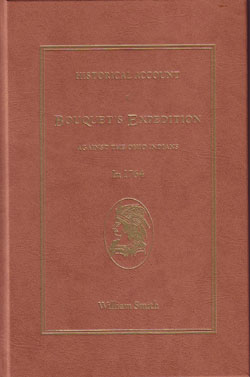
Historical
Account
of
Boquet's
Expedition
against
the Ohio Indians in 1764
By William Smith (1868)
Preface by Francis Parkman
In 1763,
Ottawa Indian war leader Pontiac, successfully united many of the
tribes in the Ohio Country. His goal was to drive all English settlers,
traders, and soldiers from the Ohio Country. Colonel Henry Bouquet was
chosen to lead an expedition into the Ohio country to put down this
Indian uprising, later to be called Pontiac's Rebellion, and the
history of this expedition is detailed in this book, originally
published in 1868. This history covers from the beginning of Pontiac's
Rebellion with the capture of Fort Sandusky to the conclusion of peace
and the return of captives in late 1764.
With preface by Francis Parkman, this
new hardcover edition of this classic book includes a two-page map, 5
special Appendices (Appendix I: Construction of Forts, Appendix II:
French Forts Ceded to Great Britain, Appendix III: Route from
Philadelphia to Fort Pitt, Appendix IV: Indian Towns on the Ohio River
and Appendix V: Indian Nations of North America) and a translation of
Dumas’ Biographical Sketch of Gen. Bouquet.
2010 ~ 160pp ~
map ~ hardcover ~ $39.95
|
|
Along the
Braddock
Road
From Cai-Uc-Tu-Cuc in 1723 to Braddock's Expedition in 1755
By Will H. Lowdermilk (1878)
Edited by R. Wenning
Excerpted
from
Lowdermilk's original book entitled History of Cumberland, Maryland,
this
volume begins with the early history of the region in the 1700s. The
earliest
written and oral history of the indigenous people begins in 1728 at the
Indian
town of Caiuctucuc, located at the junction of two streams known as the
Cohongaronta
and Caitucuc. The town was built on ground near what would later become
Cumberland, Maryland and the inhabitants of the region were a branch of
the Shawnee tribe.
The first official government venture into
this
region and westward into the Pennsylvania frontier came at the request
of
Governor Dinwiddie to reconnoiter French intentions and activity in the
region
in the early 1750s. To carry out this order, a young George Washington
was
chosen and his winter journey into Western Pennsylvania would culminate
with
his capitulation at Fort Necessity in 1754. Washington's Journal of
this
expedition forms an important part of this volume. The remainder of the
book
covers the building of Fort Cumberland and the activities that led up
to
the disastrous defeat of General Braddock in 1755. Braddock's Orderly
Books
from February through June 1755, taken from originals in the Library of
Congress,
are also included.
2005 ~ 320pp ~
8
illus. & maps ~ hardcover ~ 1-889037-39-7 ~ $39.95
|
|
The
History
of an Expedition
against Fort DuQuesne in 1755
Under Major General Edward Braddock
By Winthrop Sargent (1855)
The causes
of
the Braddock expedition's disastrous defeat is one of the great
mysteries
of colonial American history. Was it caused by poor performance of the
British
enlisted soldiers? Was it caused by British infantry tactics,
particularly
platoon volley firing at French and Indians hidden behind dense
foliage?
Was it poor strategic decision-making by Braddock? Or Braddock's
stubborn
refusal to listen to practical advice from lowly woodsmen and Indians?
This beautifully-produced volume, providing a
wealth
of answers to these questions, is the definitive history of the
ill-fated
Braddock campaign against Fort DuQuesne at the beginning of the French
and
Indian War. Originally compiled in 1855 and often cited as the best
account
of the Braddock disaster, the volume draws heavily on primary source
documents.
The book is primarily made up of two major documents: Captain Orme's
Journal
and The Morris Journal. Supporting documents and appendices include:
Braddock's
Instructions, Fanny Braddock, George Croghan's Statement, French
Reports
of the Battle, Verses on Braddock, and Braddock's Last Night in London.
The
book also features 4 double-sided, full-color maps; 2 black & white
double-sided
foldouts, and an index.
2005 ~ 432pp ~
4
maps ~ hardcover ~ 1-889037-38-9 ~ $74.95
|
|
Iroquois Wars I
Extracts from the Jesuit Relations and Primary Sources,
1535-1650
Compiled and Edited by Anthony P. Schiavo, Jr. & Claudio R.
Salvucci
This volume
chronicles
the phenomenal rise of the Iroquois Confederacy during the "Beaver
Wars"
of the 17th century. In what were perhaps the greatest series of
military
victories in Native American history, the Five Nations of the Iroquois
(the
Mohawks, Oneidas, Onondagas, Cayugas, and Senecas) defeated, destroyed,
and
absorbed enemy tribes stretching over a vast area from eastern Canada
to
Virginia to Illinois--forever changing the cultural map of eastern
North
America. During this period, the Iroquois
emerged
as a dominant force that was both respected and dreaded by neighboring
tribes
and the European colonial powers alike.
This volume gives
particular
attention to the wars between the Iroquois and the Hurons, Algonquins,
Montagnais,
and French that climaxed in total victory for the Iroquois in 1650. The
accounts
included in this volume cover the underpinnings of the wars and the
battles,
raids, and skirmishes up to and including the collapse of the Hurons. Compiled from contemporary accounts found in the Jesuit
Relations,
the writings of Cartier, Champlain, and Sagard, the
extracts
also
describe
the
evolution
of
fighting
techniques among the
eastern woodland tribes, strategy and tactics, the treatment of war
captives, the
influence of European trade, war rituals, and peace negotiations.
An introduction helps place the extracts in
their
historical context and provides a list of further reading material.
Each
extract is properly cited for easy referencing within the original
source
material, allowing the book to be used as a companion to the early
sources
or as a stand-alone reference. Three illustrations and five original
campaign
maps are provided, as well as three helpful appendices: a detailed
chronology
of events from 1533–1650; a synonymy of obscure tribal names contained
in
the volume; and nearly 50 brief biographies of individuals (explorers,
native
chiefs, and missionaries) mentioned prominently in the extracts
2003 ~ 432pp ~ 3 illus. ~ 5 maps ~ hardcover ~ 1-889758-34-5 ~ $85.00
|
This title
qualifies
for
a 10% discount when
ordered online
|
Iroquois
Wars II
Extracts from the Jesuit Relations, 1650-1675
Compiled and Edited by Claudio R. Salvucci & Anthony P. Schiavo,
Jr.
Iroquois
Wars
II continues the chronicle of the rise of the Iroquois Confederacy
during
the “Beaver Wars” of the 17th century, using primary source extracts
from
the Jesuit Relations. The accounts included in this volume cover the
incredible
series of victories won by the Iroquois over neighboring tribes
following
the defeat and collapse of their Huron enemies in 1650. Iroquois war
parties
fought wide-ranging campaigns against enemy tribes and Europeans alike
in
practically every state east of the Mississippi. In doing so, they
destroyed
or displaced dozens of tribes, many of which are known to history by
their
names alone. Extracts covering the stunning defeat of the Neutral
confederacy in the 1650s and of the long war with the Susquehannocks
(Andaste) are prominently
featured. Several detailed extracts covering the dramatic war between
the
Iroquois and the Eries are also included, along with numerous accounts
of
the French invasions of Iroquoia in the 1660s and attempts to forge a
lasting
peace.
An introduction helps place the extracts in their
historical
context and provides a list of further reading material. Each extract
is
properly cited for easy referencing within the Jesuit Relations,
allowing
the book to be used as a companion to the Relations or as a stand-alone
reference.
Six original campaign maps are provided, as well as three helpful
appendices:
a detailed chronology of events from 1650–1675; a synonymy of obscure
tribal
names contained in the volume; and nearly 50 brief biographies of
individuals
(French governors, native chiefs, and missionaries) mentioned
prominently
in the extracts.
2003 ~ 424pp ~
6
maps ~ hardcover ~ 1-889758-37-X ~ $85.00
|
This title qualifies for
a 10% discount when
ordered online
|
The
Indian
Wars of Pennsylvania
by C. Hale Sipe (1931)
Originally
published
in 1929 and revised in 1931, Indian Wars is based primarily on
documents
found in the Pennsylvania Archives and Colonial Records. This
collection
of military encounters involving the Indians on the Eastern Frontier
includes,
among others, accounts from the French and Indian War, Lord Dunmore’s
War,
Pontiac’s War, and the Revolutionary War.
This reprint was made from one of Sipe’s personal
copies,
complete with handwritten corrections in the margins and includes the
156
page supplement added to the 1931 edition. This supplemental material
features
a chronological listing of all major Indian events on the Eastern
Frontier;
a listing of all officers of the early Commonwealth of Pennsylvania; a
listing
of Indian names of Pennsylvania and their meaning; and details of
Sullivan’s
campaign against the Indians.
1999 ~ 908pp
~
paperback ~ 1-889037-10-9 ~ $44.95
|
|
Captured
by
the Indians
Seldom Told Captivity Stories of Horatio Jones and the
Benjamin
Gilbert Family
Edited by Ron Wenning (1903 & 1790)
As a result
of
the Indian campaigns against the Americans during the Revolutionary
War,
interesting and unusual Indian captivity stories abound. These two
noteworthy
narratives, epitomize the struggle between Indians and American
settlers
on the early frontier. The first involves Horatio Jones, a young
soldier
who was captured by the Senecas in Bedford County in south-central
Pennsylvania.
Hale was adopted by the Senecas, took a Seneca wife, and eventually
became
a chief who took part in tribal councils and negotiations with the U.S.
government.
The second captivity narrative involves 12 members
of
the Gilbert family who were captured in 1780. The family endured 2 1/2
years
of captivity before being released. Both of these narratives contain a
wealth
of information about Indian life in the late-18th century.
2003 ~ 304pp ~ hardcover ~ 1-889037-35-4 ~ $34.95
|
|
Diplomacy
and
Indian Gifts
The French-English Rivalry for Indian Loyalties during the
French
& Indian War Years, 1748-1763
by Wilbur R. Jacobs (1950)
During the
course
of the French & Indian War years, thousands of pounds sterling were
expended
by both the French and the British in their efforts to buy Indian
friendship
and loyalty through gift-giving. This was high-stakes diplomacy with
the
fates of two competing empires hanging in the balance. It was also a
war
for profit in which the Indians were pawns to be bought by whatever
means
were necessary to effect the outcome. Indeed, these diplomatic missions
and
this showering of gifts helped decide the war.
The details of these transactions along with their
hoped
for results are magnificently detailed in this book and come with
complete
referencing and documentation.
2001 ~ 208pp ~ hardcover ~ 1-889037-27-3 ~ $29.95
|
|
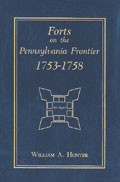
Forts on
the
Pennsylvania Frontier, 1753-1758
by William A. Hunter (1960)
With Indian
raids
and the on-going French and Indian War threatening its western borders,
Pennyslvania's
pacifist, Quaker-controlled government was slow to react. However, with
complaints
from frontier settlers reaching a crescendo, Pennsylvania unwillingly
began
a program of fortification along its frontier. By 1756, more than dozen
forts
garrisoned by Pennsylvania troops marked for the first time a boundary
between frontier settlements and a hostile wilderness.
This book covers not only the forts built by
Pennsylvania,
but also those built by the French, the Ohio Company, Viginia, and
later
the British on Pennsylvania soil during this time of conflict and
uncertainty.
Each fort is allotted a separate section, and where necessary the
account
is carried beyond the year 1758 to round out the story.
1999 ~ 596pp ~ hardcover ~ 1-889037-20-6 ~ $49.95
|
|
|
