For the scholar, student, and
interested reader...
Subjects
Native American
History & Culture
The Early Frontier
Colonial & Indian Wars
The Missions
Indian Languages
Explorers &
Pioneers
American Dialects
|
Explorers and Pioneers
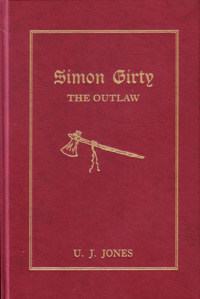
Simon
Girty, The Outlaw
With a Biographical Sketch by A. Monroe Aurand, Jr.
by U. J. Jones (1846)
Modern historians debate the accuracy of the facts
about Simon Girty’s life, but without this biography penned by U. J.
Jones in 1846, much of the information on this legendary character
from the early frontier would have been lost.
Born in 1741 near present-day Harrisburg, PA, Girty's
legendary life reads like a tale of romantic tragedy. At the age of 10,
his father was murdered by Indians. At age 15, his stepfather was
burned at the stake before his very eyes. He was adopted by the Senecas
and spent the next decade living among them in northwestern PA,
learning their language and culture.
In 1771, Girty resurfaced near Fort Pitt where
he made a name for himself as a capable frontier scout, interpreter and
spy for the Americans. His life along the Ohio River helped
him make permanent ties with both natives and whites and he served as a
frontier scout during Lord Dunmore's War. In March 1778, while
serving as interpreter for General Edward Hand during the infamous
"Squaw
Campaign", Girty became disgusted by the wanton killing of women and
children and defected to the British.
Girty, however, achieved infamy by his
participation in the torture and death of American Colonel William
Crawford at the hands of Delaware Indians. The incident established
Girty’s reputation as a "white savage"--a reputation he would enhance
by leading countless Indian excursions against the Americans after the
Revolutionary War. After Detroit was ceded to the Americans in 1796,
Girty fled to Canada where he died blind and destitute in 1818.
2008 ~ 174pp ~ hardcover ~ 978-1-889037-48-6 ~ $39.95
|
|
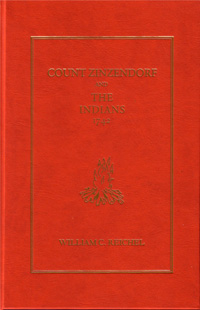
Count
Zinzendorf and the Indians 1742
Memorials of the Moravian Church
Edited by William C. Reichel (1870)
In December of 1741, Count Zinzendorf came to Philadelphia
via New York to begin a remarkable journey through the wilderness of
America searching for the original peoples—the Indians of the Eastern
Frontier. As the newly recognized head of the Moravian Movement among
the Indians of the New World, this amazing man labored far into the
frontier, traveling extensively to meet with tribal leaders such as
Shikellimy, Teedyuscung, and Tatemy. Through the eyes of this man of
the cloth are related narratives that speak to us today, giving us
glimpses in that moment in time of what life was really like on the
frontier of 1742. Zinzendorf may have failed at baptizing many Indians
to Christianity, but he paved the way for David Zeisberger and John
Heckewelder to live among the Delaware and unknowingly helped preserve
for posterity the ways of the Indians of the 18th century Eastern
Frontier.
This volume also includes a section on the
Christian Indians buried at Bethlehem, PA, and a brief chronicle
entitled Annals of Early Moravian Settlement in Georgia and
Pennsylvania. Rounding out the volume is a lengthy section entitled:
“Account of the United Brethren at Bethlehem with the Commissioners of
the Province of Pennsylvania during the Indian War of 1755, ’56, and
’57.”
2007 ~ 366pp ~ hardcover ~ 978-1-889037-45-5 ~ $49.95
|
|
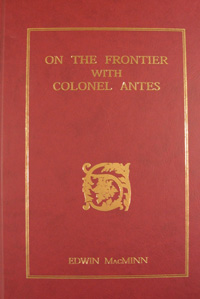
On
the Frontier with Colonel Antes
Or The Struggle for Supremacy of the Red and White Races in
Pennsylvania
by Edwin MacMinn (1900)
Colonel
Henry Antes was a key figure in the development of the Pennsylvania
frontier in the late 18th and early 19th centuries. This
remarkable man, who played such an important part in the history of the
West Branch of the Susquehanna
Valley was born in 1736 in Montgomery County, PA. Settling in the
Susquehanna Valley as a young man, he was commissioned lieutenant
colonel
of the Fourth Battalion in May of 1777. On the point
of a high bluff, just below the mouth af Antes Creek, Col. Antes built
a stockade that was frequently occupied by settlers for their
safety on the frontier.
Originally published in 1900, Edwin MacMinn
enlightens the reader with this valuable
history of a Pennsylvania militia commander and
his pioneer
family on the West Branch of the Susquehanna.
Chapters contain
information on Indian traditions, Indian village life, customs and
traits of Indian character, sickness, death and treatment on the
frontier, home life of the early settlers, early modes of
transportation, treaties with the Indians and much more. MacMinn's
accounts of Indian massacres and the "Big Runaway" on the Susquehanna's
West Branch are invaluable and his discussion of the role of women,
culture and character of the Pennsylvania frontier
people are stories rarely found in the early histories.
2005 ~ 514pp ~ hardcover ~ 1-889037-41-9 ~ $49.95
|
|
Conrad
Weiser, 1696-1760
Friend of Colonist and Mohawk
by Paul A. W. Wallace (1945)
First
published in 1945, this biography chronicles the life of Conrad Weiser,
Pennsylvania’s Indian ambassador. Born in Germany, he grew up in the
Hudson and Mohawk valleys of New York and as a youth lived several
years in a Mohawk village where
he learned the language. By the 1720s, he and his family moved to
Pennsylvania where he was employed as an agent and interpreter. Over
the course of his long and distinguished career he was a trader,
colonel in the French and Indian War, first President judge of Berks
County and founder of Reading, PA, monk at the Ephrata Cloisters,
pillar of the Lutheran Church, statesman, linguist, diplomat, and
woodsman. Governors, churchman, and Indian chiefs all relied on his
advice.
Indeed, it was his work as an Indian agent that made
his fame lasting. The Iroquois named him Tarachiawagon—“He Who Holds
The
Heavens.” His long career serves as a colorful introduction to this
fascinating
period of colonial history.
2002 ~ 648pp ~ hardcover ~ 1-889037-06-0 ~ $49.95
|
|
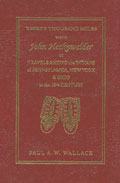
Thirty-Thousand
Miles with John Heckewelder
by Paul A. W. Wallace (1958)
This
collection, first published in 1958, follows America’s most observant
early
traveler, John Heckewelder, through the eastern woods as he recorded
invaluable
observations on the Indian life and pioneer history of the early
frontier.
From 1754 to 1813, Heckewelder crossed the Allegheny Mountains 30 times
and his adventures along the Indian trails of Western Pennsylvania into
the “Ohio Country” are interwoven with the movements of the Moravian
Indian
missions. He lived among the Indians for almost sixty years, learning
their
language, sharing their activities, recording clearly and vividly what
he
saw and heard, being most at home with the Ohio Country Indians.
1998 ~ 474pp ~
hardcover ~ 1-889037-13-3 ~ $49.95
|
|
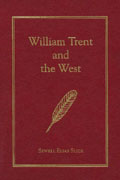
William
Trent and the West
by Sewell
Elias Slick (1947)
William
Trent's career was full of pulsing romances, forest diplomacy, and 18th
century colonial politics. Trent was deeply involved in the expansion
of
the early frontier westward into Ohio country and this biography
chronicles
his participation in the great events of the time. In his early years,
he
was a soldier of fortune, enrolling in the militia to fight the French
and
Indians. He was with General Forbes, Colonel Bouquet, and Major
Washington
as they chased the French at the forks of the Ohio. He was part of the
founding
of Pittsburgh and later in life was an Indian trader, diplomat, and
land
speculator. Statesman, entrepreneur, and adventurer are but a few ways
to
sum up the life of this extraordinary figure of the 18th century
frontier.
2001 ~ 188pp ~ hardcover ~ 1-889037-26-5 ~ $29.95
|
|
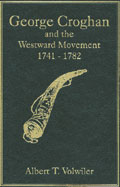
George
Croghan and the Westward Movement,
1741-1782
by Albert
T. Volwiler (1926)
George
Croghan is perhaps one of the most fascinating of the great American
early frontiersmen. Arriving in America in 1741, Croghan soon became
one of the most prominent Indian traders. When his Indian trade failed,
Croghan acted as Washington's Indian agent during the Ft. Necessity
campaign of 1754. The next year, he survived Braddock's fateful batter
and helped organize the defenses
of Pennsylvania's western border. He took part in several other
campaigns
during the French and Indian War as well.
His ability to understand
and treat with the Indians was unsurpassed. Though he once promoted an
Indian uprising against the French, he was also considered a
superlative peacemaker, having negotiated treaties with Teedyuscung and
pacified Chief Pontiac. Though he died despised
and penniless in 1782, Croghan must be ranked among the most intriguing
of the early frontiersmen.
2000 ~ 370pp ~ hardcover ~ 1-889037-22-2 ~ $39.95
|
|
|
